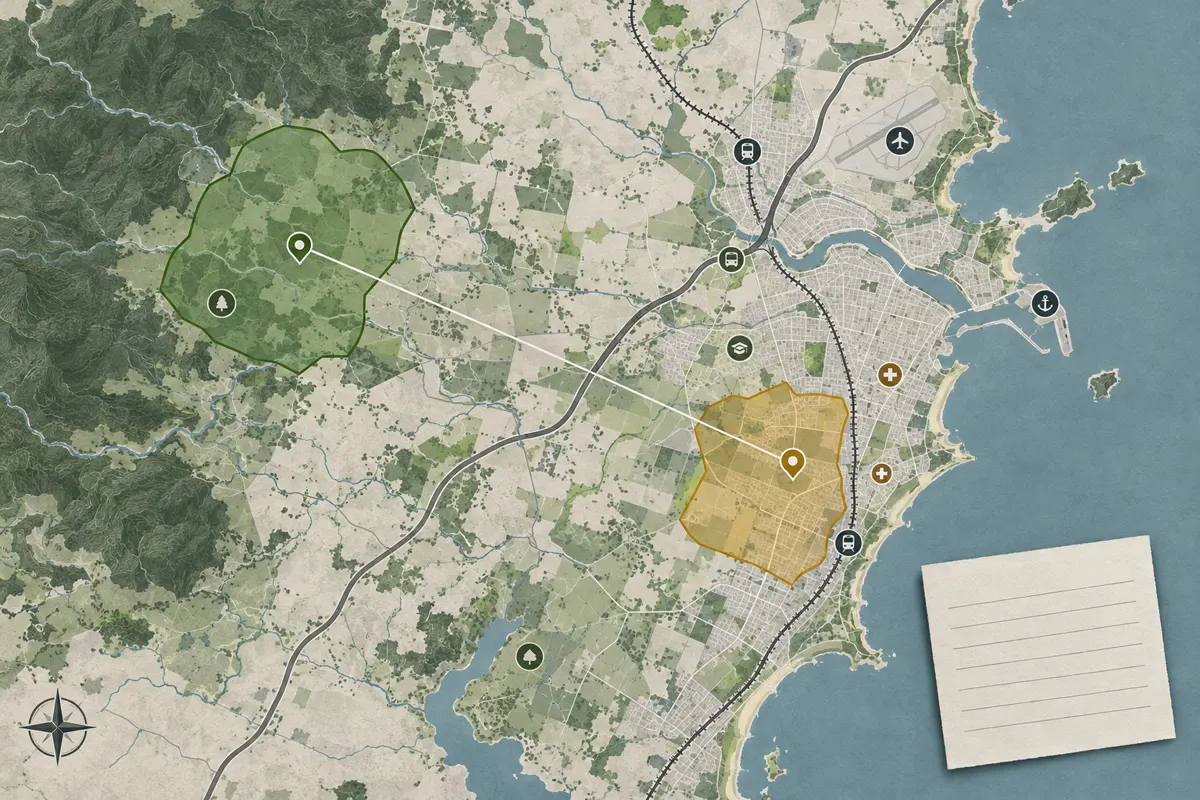
Pockets for sale
A secret pocket or property hotspot can sound like an edge. Before you trust the label, ask whether its boundary, evidence and method can be inspected and repeated.

Chris
Founder
A property advertisement promises access to a secret pocket: a few streets, an overlooked cluster or a hotspot known before the wider market catches on. The language is designed to feel more precise than a suburb. Precision only helps when you can see how the pocket was drawn and test whether the evidence supports the story.
“Pocket” is useful shorthand for a small area with a particular character or set of conditions. It can describe a real micro-market, a quiet side of a busy suburb or a group of streets shaped by the same access and amenity. It can also be a promotional label with no stable boundary at all.
Sometimes the incentive sits beyond the property in front of you. An agent, broker, agency or related party may have a commercial interest in other homes, land or developments in the area. A hotspot story can help attract buyers across several listings, build demand for a project or move stock the promoter already represents. That possibility does not prove a conflict, but it gives you a useful question: why this area in particular, and what interest does the promoter have in it? If the answer is vague or they cannot explain the evidence promptly, pause and run your own analysis.
A pocket is only useful when its boundary is defensible
Ask where the pocket starts and ends. Is the boundary based on streets, a catchment, walking routes, a development stage, sales data or someone’s local knowledge? Ask when the analysis was run, which addresses were included, which were excluded and what would make the claim change.
A legitimate proprietary method does not need to publish every commercial detail. It should still explain the question it answers, the geography it covers, the data it uses and the limits of the conclusion. A buyer cannot assess a method that is described only as secret, exclusive or available to insiders.
What a location label can tell you, and what it leaves open
| Location pattern | Potential upside | Potential trade-off |
|---|---|---|
| Secret pocket | A small area may capture a real difference in access, outlook, housing stock or local setting. | Without a mapped boundary and method, the label can expand or contract to fit the sales story. |
| Hotspot | A recent pattern in sales, demand or activity may be worth investigating. | A past pattern does not establish a future result, and the baseline or time window may be hidden. |
| Insider area | Local experience can point to questions a broad suburb report misses. | Authority is not evidence; you still need to know what was observed and whether it can be checked. |
| Whole suburb | An established boundary makes the starting geography easy to identify and compare. | A suburb can contain several different streets, interfaces, routes and housing markets. |
A hotspot is not a forecast
A map with selected circles can make a future outcome look settled. The circles may show where prices rose, where development is proposed or where an agent believes demand will move next. Those are different claims. Past performance is evidence about a past period. A proposal is not delivery. A confident prediction is not a guarantee.
This is the same trap that appears in agent-provided comparable sales. A shortlist can be genuine and still support one narrative better than another. Read our guide to cherry-picked comparables for the related question: how were the addresses selected, and do they actually match the location decision you are making?
Build a repeatable test before you buy the story
- Save the exact advertisement, wording and publication date. Marketing claims can change after you ask questions.
- Request the boundary in a form you can inspect: a map, street list, dataset or clearly named area.
- Ask for the indicator, baseline and time period. “Strong demand” needs a definition before it can be checked.
- Separate observed evidence from the prediction built on top of it. Ask what would count against the claim.
- Compare the pocket with nearby streets and the wider suburb using the same measures. A selected area should survive a fair comparison.
- Keep location evidence separate from price, building condition, title, planning and other professional due diligence.
If the answer is “trust us, we know the area”, treat that as a prompt for more research rather than proof of a scam. The person may hold useful local knowledge. You are deciding whether the claim is specific enough to influence a large purchase and whether you can explain the decision later without relying on the seller’s authority.
Make the location question yours
Kaveat takes the question in the other direction. Instead of starting with someone else’s pocket, define the Requirements and Preferences that shape your decision, then inspect candidate areas against those relationships. The area is a starting point for analysis; the score is a signal about fit with the model you chose.
That gives you a repeatable location conversation. You can explain why a road, station, school, service, coastline or other feature matters, what distance relationship you used and why two apparently similar areas score differently. Kaveat does not certify a hotspot, forecast an investment return or replace an inspection, valuation, conveyancing advice or other professional check.
The best “insider” advantage is not knowing a private name for a few streets. It is knowing which location questions matter to you, testing them consistently and understanding what the evidence cannot prove. A pocket may turn out to be useful. It should earn that status through a method you can see.