Cherry-picked comparables
A comparable sale can support a price guide without answering whether the location fits your decision. Learn how to test the addresses behind an agent’s shortlist before you negotiate.

Chris
Founder
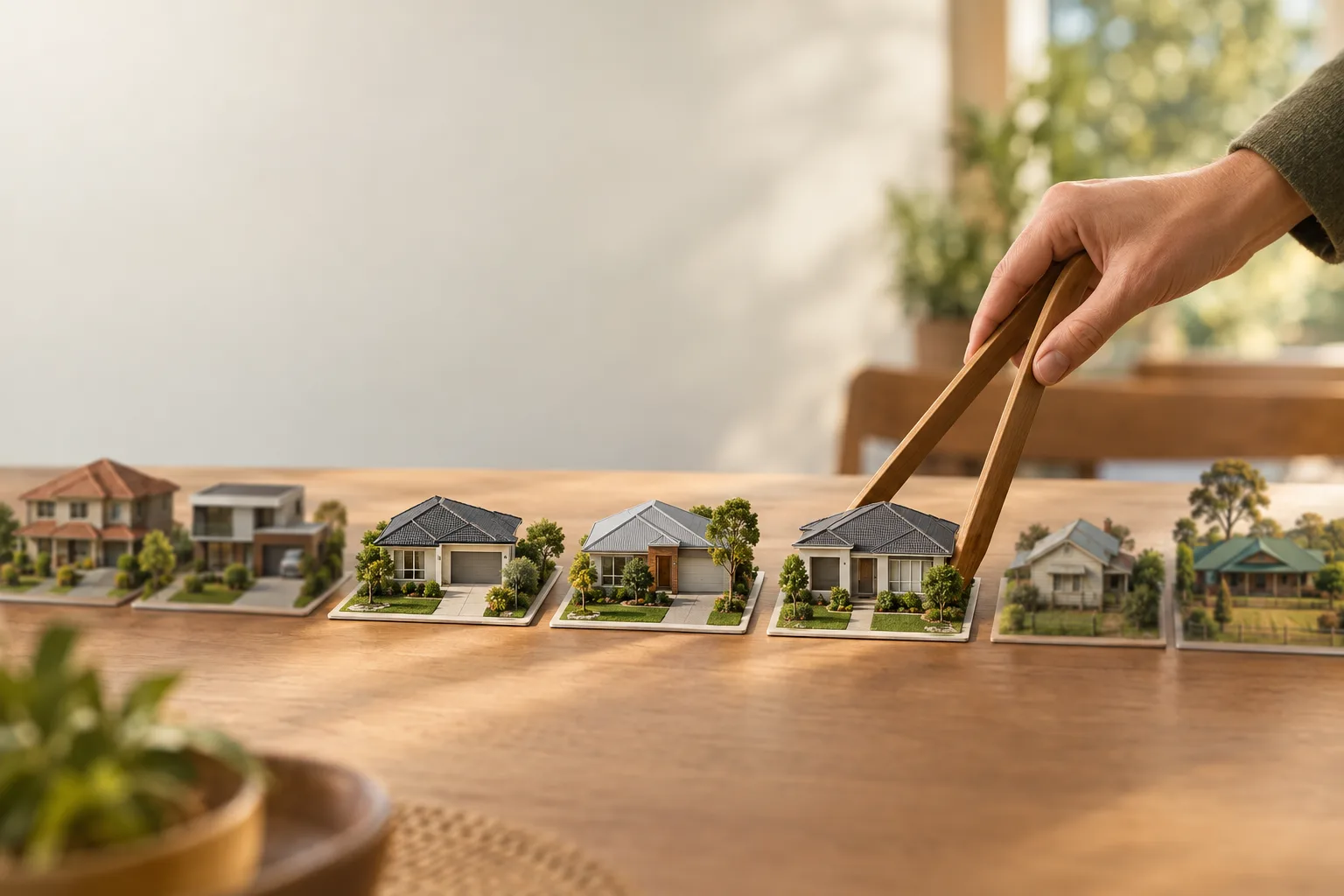
An agent hands you three recently sold addresses and says they support the price guide. The photographs look similar. The homes may share an age bracket, bedroom count and suburb. The list may be useful evidence. It is also a selection made for a particular sales conversation.
Comparable sales give a price estimate something to stand on. The useful question is how the addresses were chosen, which differences were accepted and which nearby sales were left out.
What makes a property comparable?
A comparable property covers more than another house with a similar number of bedrooms. Depending on the purpose, the comparison may consider land and building size, age, condition, renovation, design, sale date, tenure, special features and the state of the market at the time. Location can include the street, access, outlook, traffic, nearby land uses, school catchment, transport, slope and the routes people actually take.
Those factors answer different questions. A valuer may be estimating market value. An agent may be preparing a selling strategy and a price guide. A buyer may be deciding whether the home fits a daily routine, a long-term preference or a negotiation position. The same three addresses can be relevant to one question and weak for another.
The rules require evidence for the estimate
Australian property regulation is state and territory based. In Victoria, Consumer Affairs Victoria says an estimated selling price must be reasonable and based on research into comparable properties. Its guidance identifies factors such as location, size, age, condition, standard and sale date, and requires agents to keep evidence for the estimate. NSW guidance also expects a reasonable estimate supported by evidence and comparable sales, with records that can be reviewed under the applicable rules.
These obligations give buyers and sellers a basis to question a price guide, and misleading price representations can breach Australian Consumer Law. The rules do not require a buyer’s shortlist to cover every sale or include a location analysis built around that buyer’s priorities. A Property Price Statement or comparable-sales list is useful price-estimation evidence. It cannot answer whether the address is right for you.
How cherry-picking happens without a fabricated sale
An agent can cherry-pick without inventing a property or misrepresenting a sale. A narrow, defensible selection can still favour the story being told. The chosen homes may support a higher offer, reassure you that the asking price is justified or make a vendor’s expectation appear more settled than the wider evidence suggests.
The agent represents the vendor in the sale process. Recommendations can still be fair and lawful. A buyer should separate the agent’s commercial argument from an independent assessment of the location. Recent sales within the suburb or within four kilometres can be a useful starting point, while still missing the qualities that matter to your household.
The location questions behind a comparable
| Location pattern | Potential upside | Potential trade-off |
|---|---|---|
| Same suburb | It may provide a useful local market reference and similar broad planning context. | A different street, road hierarchy, slope, outlook or transport interface can change the lived location. |
| Same distance | A radius can quickly create a starting set of nearby sales. | Straight-line distance can ignore barriers, crossings, traffic, noise, access and the route a household would use. |
| Similar house | Age, size, condition and renovation can make the physical asset easier to compare. | The surrounding location may contribute a different level of access, quietness, amenity or exposure. |
| Similar sale price | It can show where buyers have recently paid for a broadly similar package. | Price similarity does not prove that the locations deliver the same fit for your priorities. |
Build a second set of comparables
Start with the addresses the agent provided. They show which properties the sales conversation treats as comparable. Add a small set of your own, including nearby homes that appear to have been left out and properties in the same practical search area that differ in the location qualities you care about.
- Record the address, sale date, sale price and the source of each comparable.
- Separate the house evidence from the location evidence instead of allowing a renovated kitchen to stand in for the whole address.
- Mark the location differences that could affect your routine, such as a busy road, rail corridor, difficult crossing, steep route, school traffic or missing services.
- Decide whether each difference should change your price, your willingness to proceed or the questions you need answered.
- Keep the agent’s list and your list side by side so the selection remains visible during negotiation.
Use location evidence to question the premium
Location is one part of the decision that cannot be renovated after settlement. A buyer can replace a kitchen, repaint a room or improve a garden. Moving a road, changing a station route, removing a nearby land use or shortening a daily journey sits outside the renovation budget.
Kaveat Comparo lets you put shortlisted addresses side by side against the same saved location model. Paste in the agent’s addresses, add your own candidates and check whether the locations match the priorities you set. If one home scores lower, you have a precise question to ask: if it is being priced alongside the other, what explains the weaker location fit?
The score is a decision-support signal for location comparison. It is not a valuation, market forecast or guarantee that a lower offer will succeed. It reflects the Requirements and Preferences you chose, the geographic relationships available in the model and the assumptions that still need checking. That gives you an explainable location question, so you can assess price and other quality aspects separately.
A comparable list should sharpen your questions
Use the list as a starting point. Ask what each address was meant to prove, what was excluded and why. Check whether the homes share the location qualities your decision depends on. Suburb names and radius rules can help organise a search, but they are not a complete method.
Comparables help buyers and sellers understand a market. Kaveat adds a location lens that keeps each address visible and comparable against the same personal model. It will not produce a negotiating number. It can help you identify a weaker location, recognise a genuine fit and ask why the price should be the same.
Sources and further reading
- Consumer Affairs Victoria: Underquoting information for real estate agents
- Consumer Affairs Victoria: Tackling underquoting through new comparable property guidelines
- Consumer Affairs Victoria: Understanding property prices and underquoting for buyers
- NSW Government: Underquoting guidance for property professionals
- NSW Government: Price estimation and underquoting when selling a property
- ACCC: Real estate
- ACCC: Gary Peer & Associates found to have misled buyers