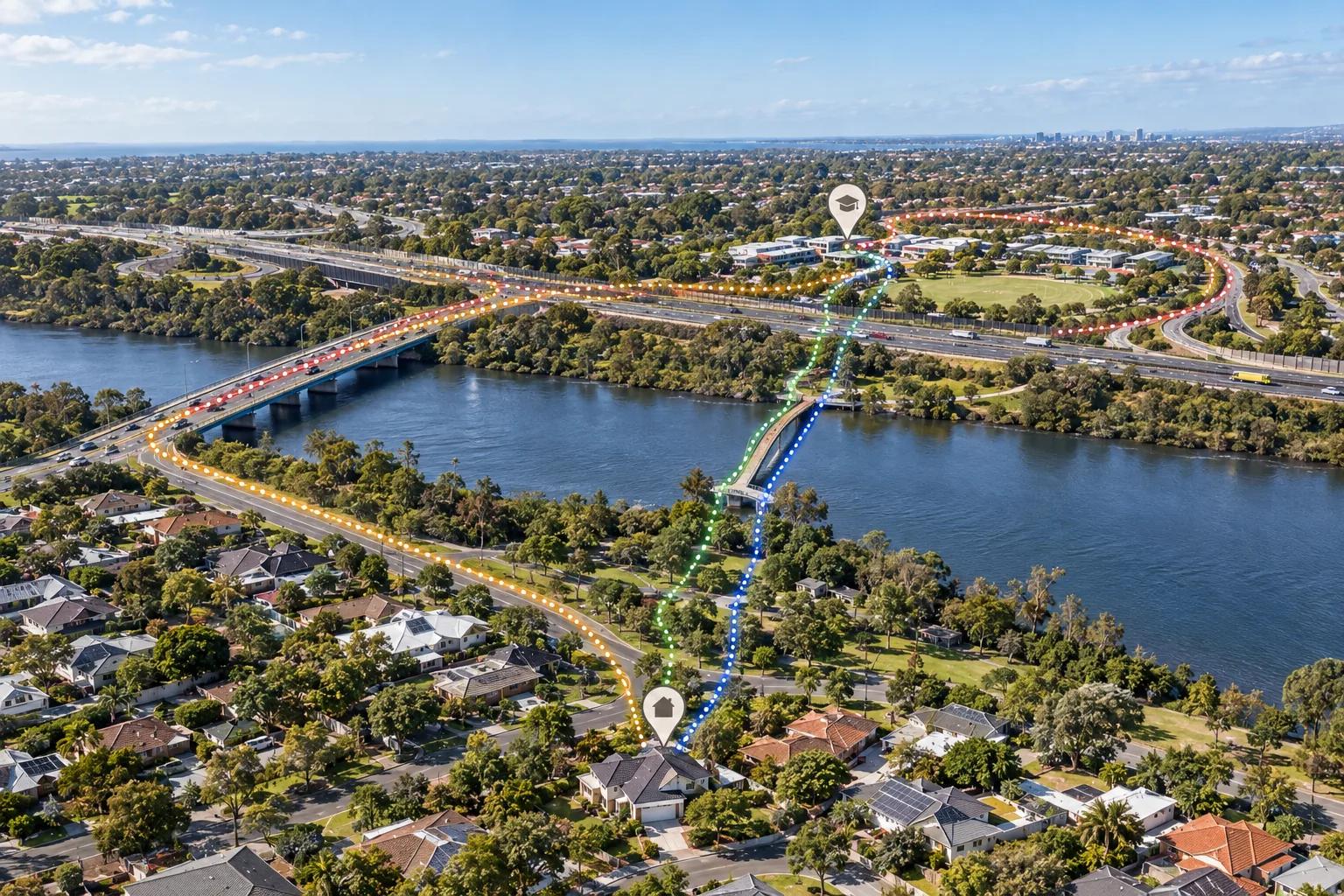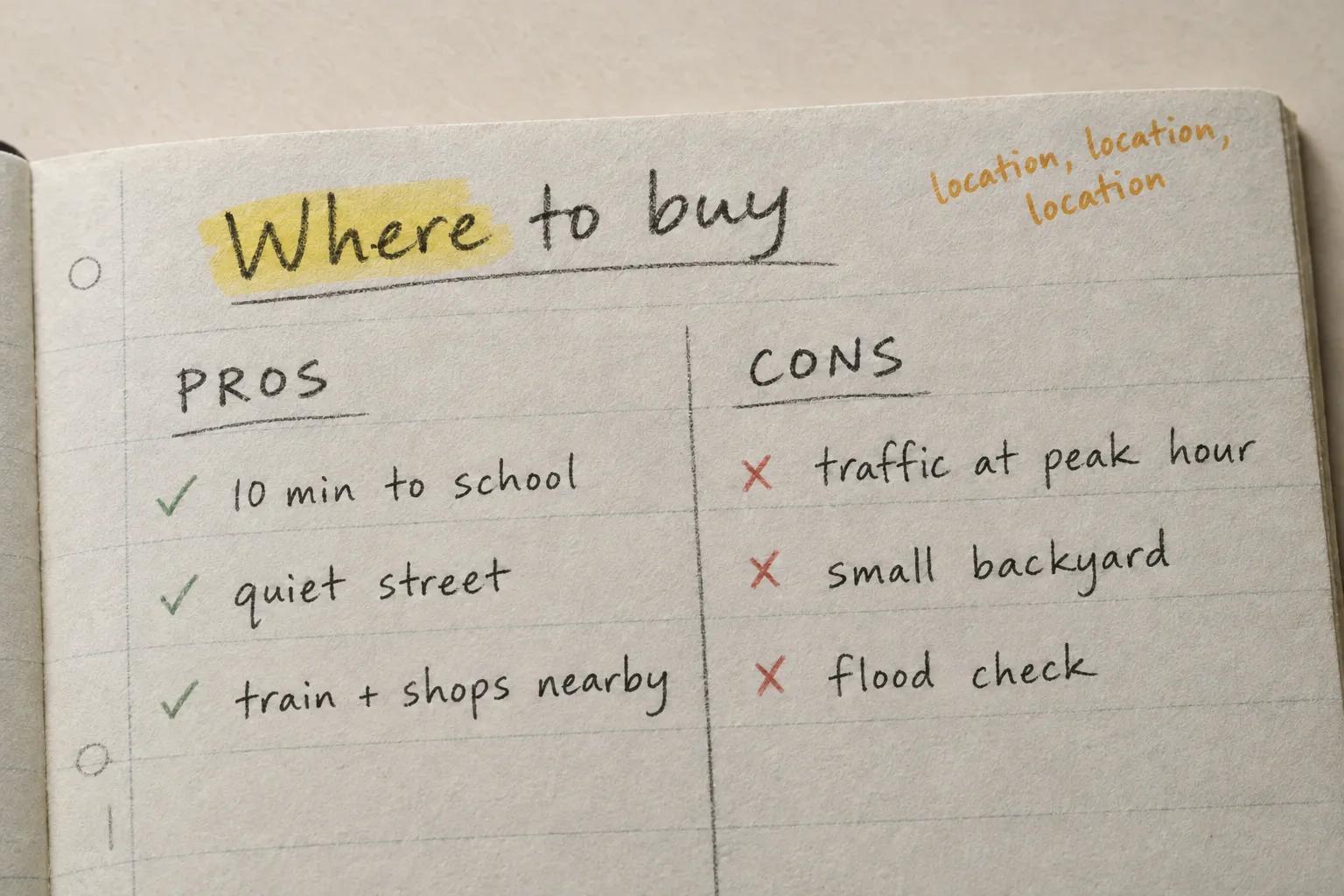
Should a school decide where you live?
A walkable school can give a family back time and independence. The same address can bring sirens, traffic and a price premium, while private fees can make staying put look different from a move. Start with your week, not the school’s reputation.

Kim
Support Manager
“Good schools nearby” is one of the quickest ways to narrow a property search. It can make a listing feel safer, justify a stretch in the budget and settle the suburb choice before anyone has walked the route or checked the school’s actual enrolment rules.
For some households, that shortcut points to a genuinely important daily benefit. For others, it points towards a premium, a noisy street and a resale argument that may never matter to the people living there. School location deserves attention alongside the other questions that shape a week.
When the walk is the point
A nearby school can change the shape of a weekday. A child may eventually walk, ride a bike or use a scooter. A parent may walk with them instead of joining the morning school-run queue. That shorter trip can leave room for breakfast, work, sleep, sport or the small conversations that are hard to schedule once everyone is in the car.
That benefit depends on the route, not the radius. A school may be close as the crow flies and still sit behind a busy road, a difficult crossing, a missing footpath or a route that feels unsafe at the time it will be used. Distance is a useful first filter. It is not a safety assessment.
- Trace the route at the actual school-run times, including the crossings and road edges.
- Separate a route you would walk with a younger child from one an older child could manage independently.
- Include the return trip, wet-weather plan, after-school activities and the route to work.
Close to a school can mean close to its busiest moments
The school gate is also a working place. Sirens, announcements, sport carnivals, whistles and children calling across a yard are part of the soundscape. Drop-off and pick-up bring car traffic, reversing vehicles, blocked driveways and short periods when a quiet residential street behaves like a transport interchange.
That can be a fair trade for a family who wants the walk. It can be a poor trade for someone who works nights, records from home, protects a quiet garden, or simply does not want school activity at the front boundary. Visit at the start and end of the school day. Look at where the noise travels, how long it lasts, and whether the house gives you a quieter side to live on.
A catchment is a boundary, not a guarantee
Popular, well-regarded schools can put pressure on nearby home prices. Research and market reporting have found price differences around some school boundaries. That helps explain why a catchment can influence a budget before a family has compared the homes themselves.
The boundary still needs checking. Enrolment rules differ by jurisdiction and school. They can change, and living nearby does not turn a property listing into a guaranteed place. Confirm the current official policy, the exact address boundary, out-of-area rules and the school year that matters to your household.
The premium may be real. The assumption is the trap.
Paying more to enter a popular school zone can be a rational choice when the school is central to your family’s daily life. It can buy access, a shorter commute and a larger pool of future buyers who share that priority.
It can also become a story people repeat without checking what it means. A higher purchase price is evidence of demand at that moment. It does not prove that the property will hold its value better, outperform a neighbouring suburb, or suit the next stage of your life. The school may change. The catchment may change. Your household may change first.
A school-zone premium is a price observation. It is not a prediction.
Relocate for the catchment, or pay for the school?
A move into a public-school catchment and a decision to stay and pay for private schooling solve different problems. Moving changes the address itself. That may mean a shorter school trip, a different home, a new commute, less access to family support or a higher mortgage. Private schooling can preserve the home, neighbourhood and routines that already work, while adding a recurring cost and its own admissions, transport and timetable decisions.
The costs arrive differently, which makes them easy to underestimate. As an illustration, $15,000 a year for 13 school years is $195,000 before fee increases, uniforms, devices, excursions, transport or other charges. At $25,000 a year, the same simple multiplication reaches $325,000. Those figures are scenarios, not a national fee estimate. Feesable and McCrindle reported a 6% increase in average school fees from 2024 to 2025, and found that 92% of parents considered knowing the full cost important. Model the fee schedule for the actual school rather than relying on a headline tuition number.
A catchment premium needs the same care. Paying more for a home is a different commitment from spending the money on fees. The premium remains tied to an asset, but the move may also bring stamp duty, selling costs, mortgage interest, renovations and a different commute. A price difference around a school boundary can show demand. It cannot tell you which option leaves your household with more flexibility or a better week.
A catchment gives you a rule to verify
Public-school enrolment rules differ by state and territory. NSW describes local enrolment areas and a guaranteed place for children who live inside them. Victoria gives eligible children the right to attend their local school, while Queensland catchments give local students priority and can place out-of-catchment applications on a waiting list when capacity is limited. Check the official map, the enrolment year, residency evidence and the school’s current policy before treating a boundary as a benefit.
Private schools may draw students from a much wider area and generally set their own admissions processes. That can remove the need to buy inside one particular public-school boundary, but it does not remove scarcity. Waiting lists, entry points, scholarships, sibling policies, transport time and the school’s fee schedule all belong in the decision.
Staying now can be a deliberate strategy
There is a third option between moving immediately and committing to private fees for every year. A household might stay in a home with the better commute, quieter street, stronger family support, more suitable housing or easier access to work, then revisit the public-school move when the relevant school years are closer. That plan carries uncertainty: prices and boundaries can change, and a future place is never guaranteed. It can still be more honest than paying a premium today for a school need that is years away.
- Compare the all-in cost of moving with the all-in cost of fees, including the time and transport each option requires.
- Test whether the current home still works for the years before school, and for the adults who will carry the daily routine.
- Check the actual public-school boundary and private-school admissions policy for the year that matters, rather than relying on a listing description.
- Run the decision again if the household, work pattern, support network or school priorities change.
If you do not have children
A school may still matter to you. You may value the open space, the bus routes, the neighbourhood activity or the long-term demand around a well-known school. You may also prefer to live away from the busiest edges, especially if other location factors shape your week more strongly.
Buying into a catchment solely for a future resale story asks you to pay for a benefit you may never use. A quieter street, a shorter commute, better access to friends, a park, a station or a local centre may have more value to your life than a school name in a search filter.
If you do have children
Ask which school and location support the life your household can actually sustain. A ten-minute walk may matter more than a reputation that adds an hour of driving. A less fashionable school with a workable route may create more time and less daily stress than a distant school with a celebrated score.
Children grow, interests change and family arrangements move. Consider the school years you are planning for, the work commitments that sit beside them, the people who will handle pick-up, and how the household will function when the easiest school-run option is no longer available.
Use the school as one requirement among several
Give the school the weight it deserves in the location model. It can be a firm requirement, a preference, a destination to reach safely, or a factor you deliberately leave out. The useful part is making that choice visible beside work, transport, services, family, quietness, housing and budget.
Use Kaveat to compare the location around an address against the priorities you choose. Start with the property-buyer use case to model the household’s routines, then inspect candidate areas and addresses with the school route in context. The result is a clearer decision, not a guarantee of school quality, enrolment or future property value.
Sources and further reading
- Australian School Travel Survey 2025, Monash University
- Austroads: Safer, healthier travel to school
- The impacts of public schools on housing prices of residential properties
- Cotality: Families pay six-figure premiums for top public school catchments
- NSW Government: Find and select a primary school
- Victorian Government: School zones
- Queensland Government: School catchment areas
- Feesable and McCrindle: School Fees in Australia 2025