
Make the 20-minute idea specific to your week
Victoria's 20-minute neighbourhood guidance offers an 800-metre planning reference for everyday needs.
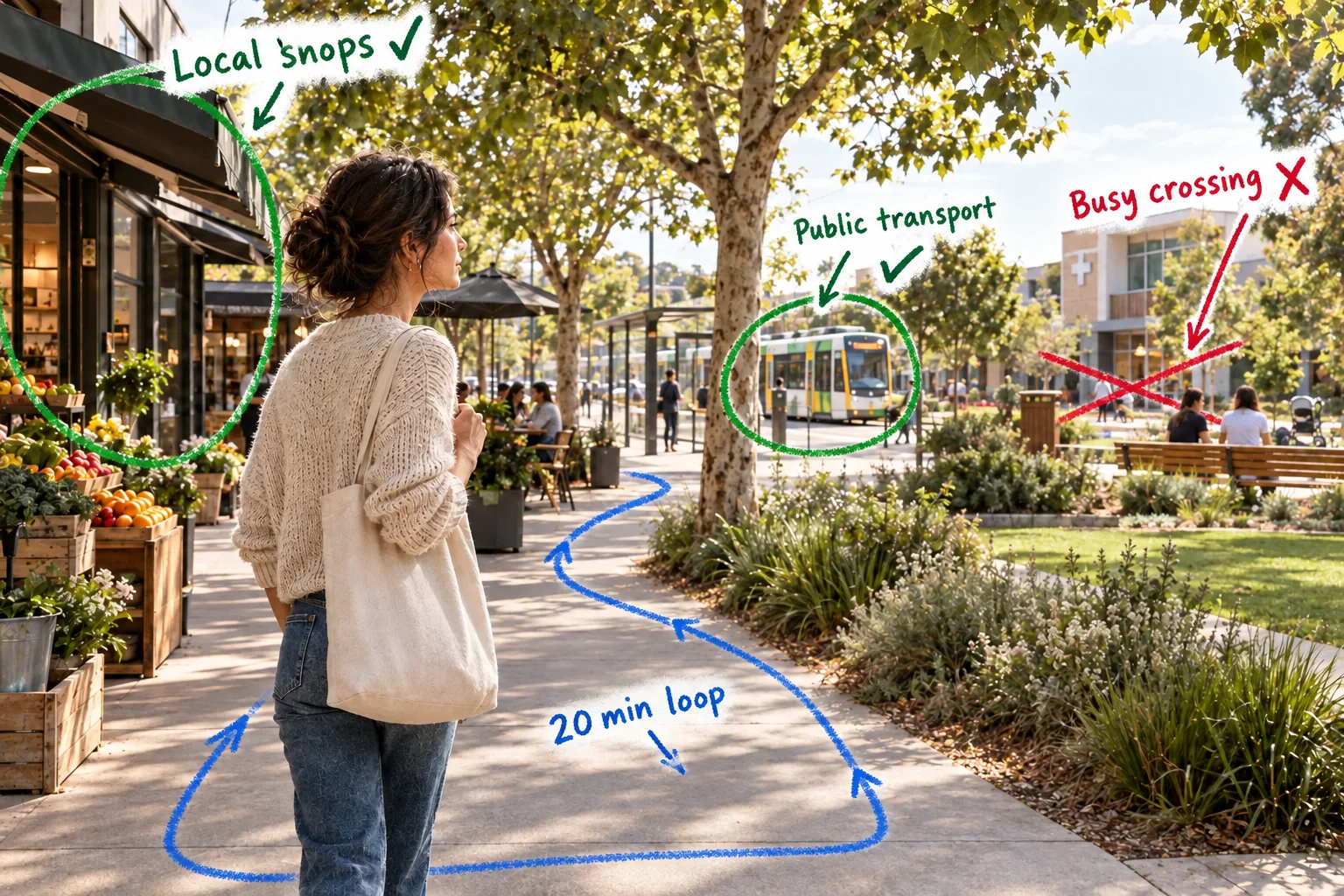
Use it as a starting point, then define your own destinations, distances, transport options, and avoidances in Kaveat.
Emptor → Kaveat Area context
The decision problem
An 800-metre circle is a benchmark, not your daily life
A planning guide can define a useful reference distance, but it cannot choose the clinic, station, shop, footpath, shade, terrain, or destinations your household actually uses.
A personal model makes those choices explicit before a walkability label does the thinking for you.
Emptor → Kaveat Area
List the destinations that shape your week, such as groceries, healthcare, work, education, parks, and public transport.
Set realistic distances and travel times for your household, then separate requirements from preferences and avoidances.
Review candidate areas against the model, inspect the Kaveat Score breakdown, and ground-truth routes and service quality in person.
The Kaveat way
Turn the location question into a repeatable workflow
Define what matters, inspect the spatial result, and carry the same reasoning into the next supported step.
The intended route is Emptor → Kaveat Area. It shows where this use case begins, not a promise that every adjacent capability is available here.
Trust the inputs
Make the reasoning clear
Kaveat keeps the inputs behind a location result in view. Use that evidence to decide what to investigate next, then add the checks the property or situation requires.
A personal score, not a universal score
The Kaveat Score is a decision-support signal from active Requirements and Preferences. It shows alignment with your model, not a universal walkability grade.
- Inputs stay visible
- The model can be revisited
- Further checks remain yours
The boundary
Use the model as evidence, not a verdict
Kaveat should help you ask a better location question, not make the final decision for you.
The 800-metre measure is a guide, not a certification. Kaveat does not certify a 20-minute neighbourhood, guarantee route safety or service quality, or replace checking footpaths, crossings, shade, opening hours, accessibility, and the lived experience of an area.
Is this the same as a generic walkability score?
Generic scores can be a useful starting point. Kaveat lets you define the places, distances, travel modes, and trade-offs that make a neighbourhood work for your household, then inspect the result against that model.
Does Kaveat calculate a Walkabout score?
Walkabout is a proposed editorial label for a personal walkability-style model, not a current product feature. Today, Kaveat uses the Kaveat Score to express how a location aligns with your active Requirements and Preferences.
Does 20 minutes mean every trip will take 20 minutes?
No. It is a planning benchmark based on an approximate return walk. Use it to frame the question, then validate actual routes, transport, accessibility, service quality, and the trips that matter to you.
Context and sources
Victorian Government: 20-minute neighbourhoodsReady to capture your location needs?
Define and score every location, everywhere that's important to you.