
Make a Vastu Shastra brief visible before you choose a plot
Within Hinduism and wider Indian architectural traditions, Vastu Shastra is a traditional approach to site and building design that considers cardinal directions, the Vastu Purusha Mandala, the five elements, plot shape, soil, slope, water, and the entrance.
For an India-based or diaspora household, shop, office, or development project, use Emptor to record the approach your Vastu practitioner follows, compare candidate areas, and then inspect individual plots without confusing a spatial shortlist with a Vastu verdict.
Emptor → Kaveat Area → Comparo context
The decision problem
A Vastu brief can start with a plot, but the search starts earlier
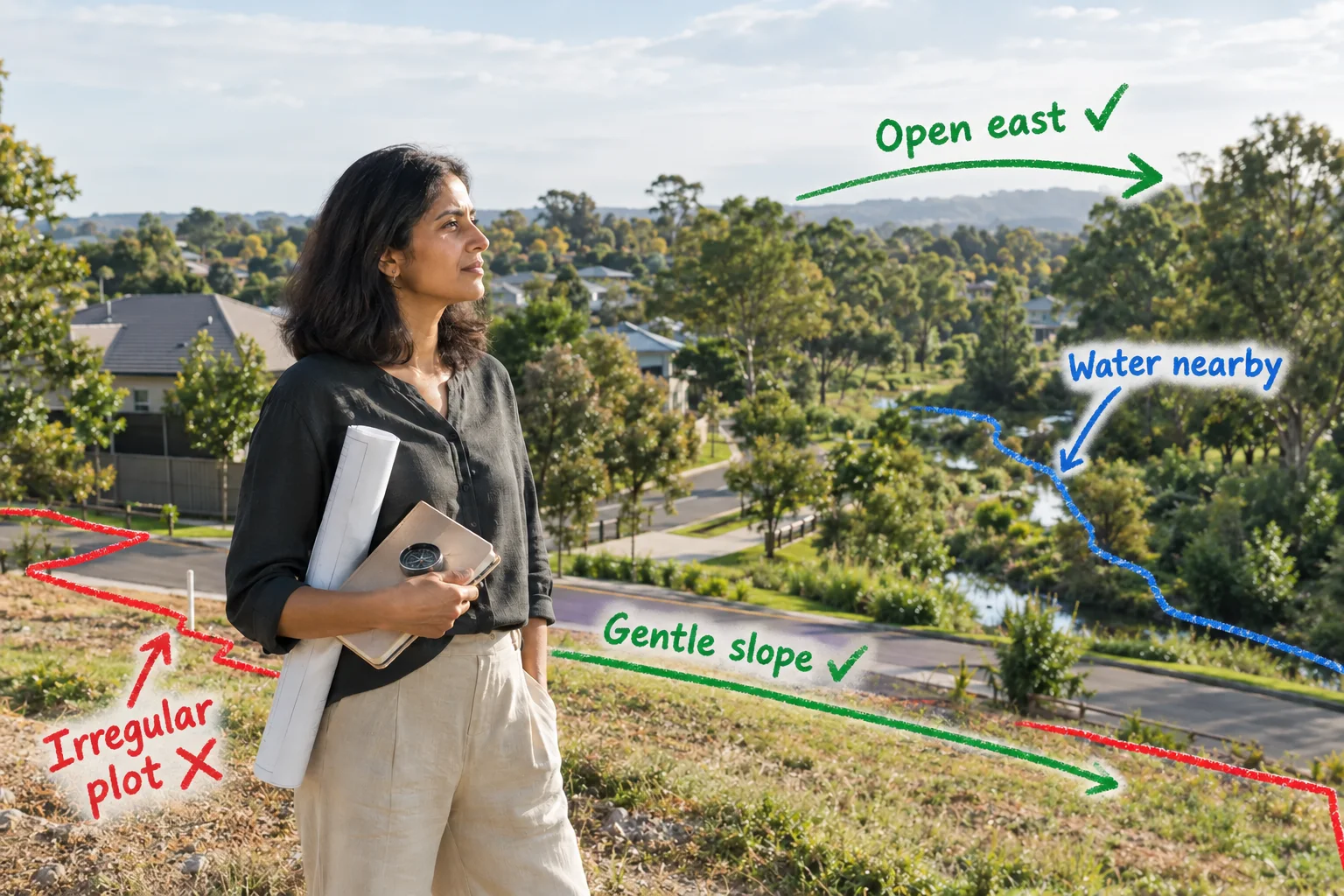
A Vastu Shastra brief may start with the plot facing and cardinal directions, then extend to the Vastu Purusha Mandala, Panchabhutas, entrance, plot shape, soil, slope, water, open space, roads, neighbouring uses, daylight, and access.
Guidance varies by lineage, practitioner, climate, and hemisphere. A direction or slope preference used for a home in India may not transfer directly to an Australian site, and practical checks such as drainage, planning, access, and soil conditions still matter.
Those factors are difficult to hold consistently across a long shortlist. Kaveat makes the macro-location questions explicit before a preferred property takes over the decision, while the chosen Vastu interpretation remains with the household and its practitioner.
Emptor → Kaveat Area → Comparo
Define the directional and entrance preferences your chosen school or practitioner uses, such as an east, north, or northeast-facing plot, cardinal and intercardinal orientation, the Vastu Purusha Mandala, or a particular Panchabhutas framework.
Add land and neighbourhood context such as open space, greenery, water, slope, elevation, road approach, access, nearby uses, and the quiet or practical qualities that matter to the household or business.
Record plot-shape and soil questions, including square or rectangular geometry, level or graded terrain, firm or uncontaminated soil, drainage, and site history, while treating survey and environmental checks as separate work.
Compare candidate areas and addresses, then confirm compass orientation, title boundaries, soil, levels, drainage, planning constraints, building design, and the chosen Indian or Southern Hemisphere interpretation with the appropriate professionals.
The Kaveat way
Turn the location question into a repeatable workflow
Define what matters, inspect the spatial result, and carry the same reasoning into the next supported step.
The intended route is Emptor → Kaveat Area → Comparo. It shows where this use case begins, not a promise that every adjacent capability is available here.
Trust the inputs
Make the reasoning clear
Kaveat keeps the inputs behind a location result in view. Use that evidence to decide what to investigate next, then add the checks the property or situation requires.
A location model for a tradition-led brief
Kaveat can compare candidate locations against the Requirements and Preferences you choose. A higher Kaveat Score means closer alignment with that model, not proof that a site is Vastu-compliant, auspicious, healthy, prosperous, or suitable for a particular project.
- Inputs stay visible
- The model can be revisited
- Further checks remain yours
The boundary
Use the model as evidence, not a verdict
Kaveat should help you ask a better location question, not make the final decision for you.
Vastu Shastra is an Indian cultural and spiritual tradition with Hinduism and wider Indian architectural associations. Kaveat does not interpret the Vastu Purusha Mandala, measure prana or chakras, determine auspiciousness, predict health, wealth, or fortune, certify a site, or recommend remedies.
Southern Hemisphere adaptations are interpreted differently by different practitioners; choose and document the approach you want to use before comparing locations.
Kaveat can support available geographic comparisons. Compass orientation, plot shape, soil quality, slope, drainage, flood risk, building design, planning, environmental, legal, and financial checks require independent verification.
Does Kaveat calculate Vastu or decide whether a plot is auspicious?
No. Kaveat compares locations against the Requirements and Preferences you define. It does not interpret the Vastu Purusha Mandala, measure energy, or issue a Vastu verdict. Use it to structure the shortlist alongside your chosen practitioner or tradition.
Which direction is best for a Hindu or Vastu home?
There is no single approach shared by every Vastu school or practitioner. East, north, northeast, entrance padas, sunlight, site context, and the hemisphere may be treated differently. Kaveat lets you record the approach you have chosen; confirm the interpretation with your practitioner.
Can Kaveat confirm a plot's shape, soil, slope, water, or entrance direction?
Only to the extent that the relevant data is available and represented. Confirm title boundaries, survey measurements, soil and contamination, levels, drainage, access, compass bearings, and building design independently before relying on a site decision.
Does the Australian Southern Hemisphere change Vastu guidance?
Practitioners disagree on how Vastu should be adapted outside India. Kaveat does not choose between those approaches; record the framework you want to test and ask a qualified practitioner to interpret the result for the specific site.
Ready to capture your location needs?
Define and score every location, everywhere that's important to you.