
Bring chi, sha chi, and auspicious surroundings into your location brief
Feng shui, meaning wind and water, treats the relationship between people and their surroundings as part of a location decision. For a home, shop, office, or investment property, land, water, roads, entrances, sunlight, and the wider neighbourhood can all form part of the brief.
Use Emptor to record the geographic factors you want to encourage or avoid, then compare areas and addresses against the same personalised model.
Emptor → Kaveat Area → Comparo context
The decision problem
A cultural brief is personal. The shortlist still needs structure
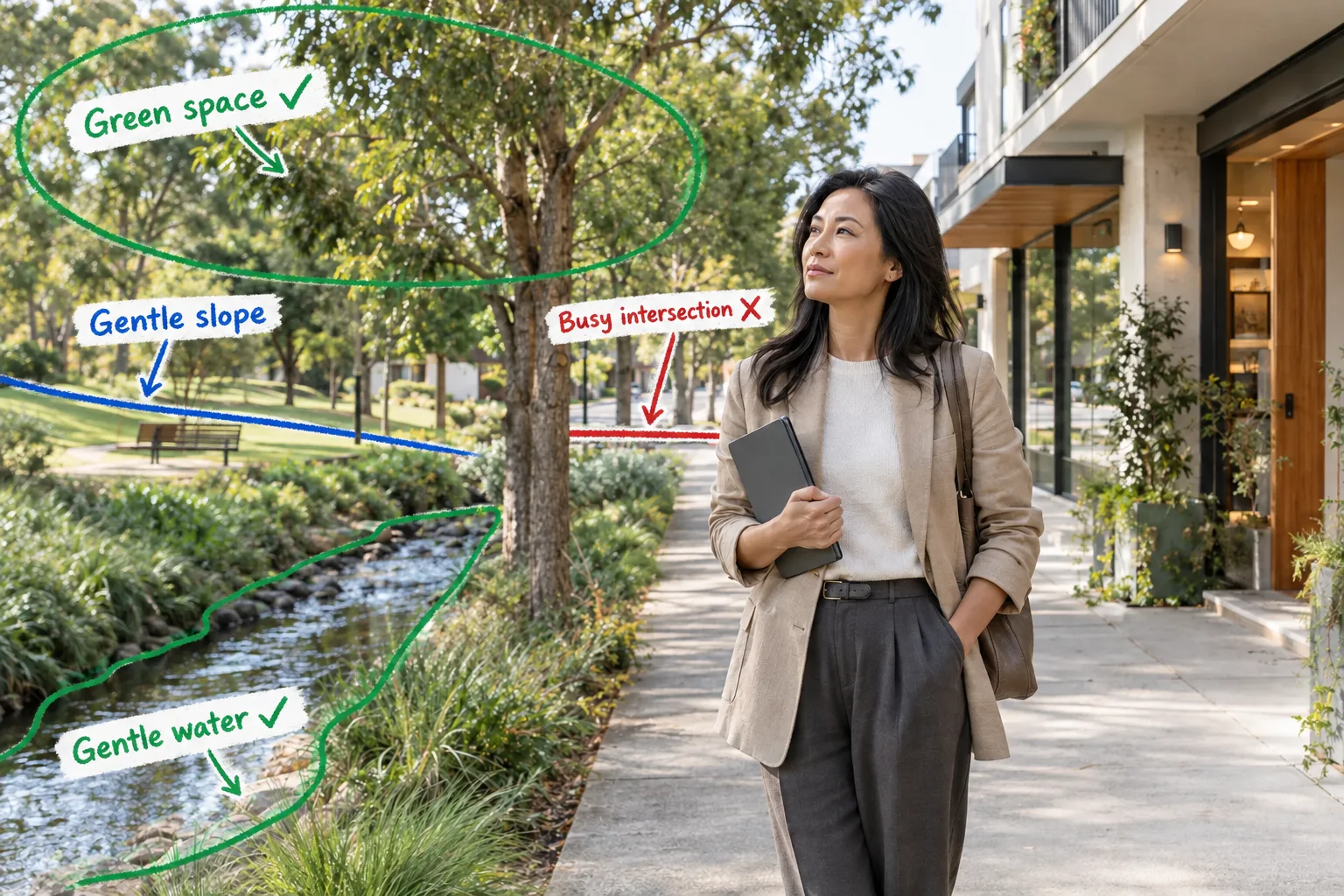
A feng shui-informed review may ask whether chi can gather calmly around an auspicious landscape: an open outlook, gentle water, supportive higher ground, balanced orientation, sunlight, and a clear entrance or Mouth of Chi. It may also look for sha chi, including T-junctions, poison arrows, sharp angles, fast traffic, stagnant water, or a property hemmed in between major roads.
Those cues are meaningful to people who use feng shui, but they are difficult to compare consistently across a long shortlist. Kaveat makes the supported geographic parts of the brief visible, including roads, landform, water, green space, nearby uses, access, and address data, while leaving interpretation, interior arrangement, and professional checks with the practitioner.
Emptor → Kaveat Area → Comparo
Define auspicious context you want to investigate, such as an open field or gentle slope in front, gentle flowing water at a safe distance, higher ground behind the site as a tortoise-like support, greenery, sunlight, and a calm secondary road.
Add potential sha chi or poison-arrow avoidances such as a T-junction, a straight road aimed at the property, sharp neighbouring angles, major-road exposure, a site between busy roads, or other features your practitioner considers relevant. Separate Requirements from Preferences.
Treat the front entrance as a location question as well as a building question: the Mouth of Chi should be visible, welcoming, well-lit, and unobstructed, while orientation, lot shape, level or meandering land, earth chi (Di Chi), and address symbolism may need separate site or property checks.
Compare candidate areas and addresses, then verify compass direction, frontage, water, slope, access, building form, floor plan, and any feng shui interpretation with your own research and a qualified practitioner.
The Kaveat way
Turn the location question into a repeatable workflow
Define what matters, inspect the spatial result, and carry the same reasoning into the next supported step.
The intended route is Emptor → Kaveat Area → Comparo. It shows where this use case begins, not a promise that every adjacent capability is available here.
Trust the inputs
Make the reasoning clear
Kaveat keeps the inputs behind a location result in view. Use that evidence to decide what to investigate next, then add the checks the property or situation requires.
A preference model for the whole shortlist
Kaveat can compare candidate locations against the Requirements and Preferences you choose. A higher Kaveat Score means closer alignment with that model, not proof that a site has auspicious chi, avoids sha chi, improves health or fortune, or will produce a commercial outcome.
- Inputs stay visible
- The model can be revisited
- Further checks remain yours
The boundary
Use the model as evidence, not a verdict
Kaveat should help you ask a better location question, not make the final decision for you.
Feng shui is a cultural and spiritual system, and Kaveat does not measure chi, certify an auspicious site, diagnose sha chi, predict luck, or replace a qualified practitioner. Kaveat can help model supported geographic factors and address attributes, but it does not assess the Mouth of Chi, interior arrangement, commanding position, cures, compass readings, building form, lot boundaries, safety, drainage, flood risk, noise, medical or environmental impacts, legal matters, or commercial viability. Verify current data and complete professional due diligence.
Does Kaveat calculate chi or decide whether a site is auspicious?
No. Kaveat compares locations against your chosen Requirements and Preferences; it does not measure chi, diagnose sha chi, or issue a feng shui verdict. Use it to structure the geographic shortlist alongside your own beliefs and practitioner advice.
Can Kaveat check the Mouth of Chi or commanding position?
Kaveat may help you investigate external access, roads, frontage, and surrounding context where relevant data is available. It does not inspect whether an entrance is clear or welcoming, assess furniture placement, or replace a building-level feng shui review.
Can I avoid the number 4 or prefer 8?
Address numbers can be included as a preference where address data is available. Treat this as a symbolic criterion, separate from physical location factors, and verify how the address is recorded.
Can Kaveat suggest feng shui cures?
No. Kaveat can help you compare another site or make a preferred location easier to investigate. Cures, building changes, floor plans, orientation advice, and interior arrangements require a qualified practitioner or other relevant professional.
Ready to capture your location needs?
Define and score every location, everywhere that's important to you.