
Plan around Shabbat, community, kosher access, and family life
For some Jewish households, the right location depends on more than a suburb label: an active eruv, a realistic walk to a preferred shul, Jewish education, kosher food, mikvah access, and the community routines that make the week work.
Emptor → Kaveat Area → Comparo context
The decision problem
A Jewish location brief can be highly practice-specific
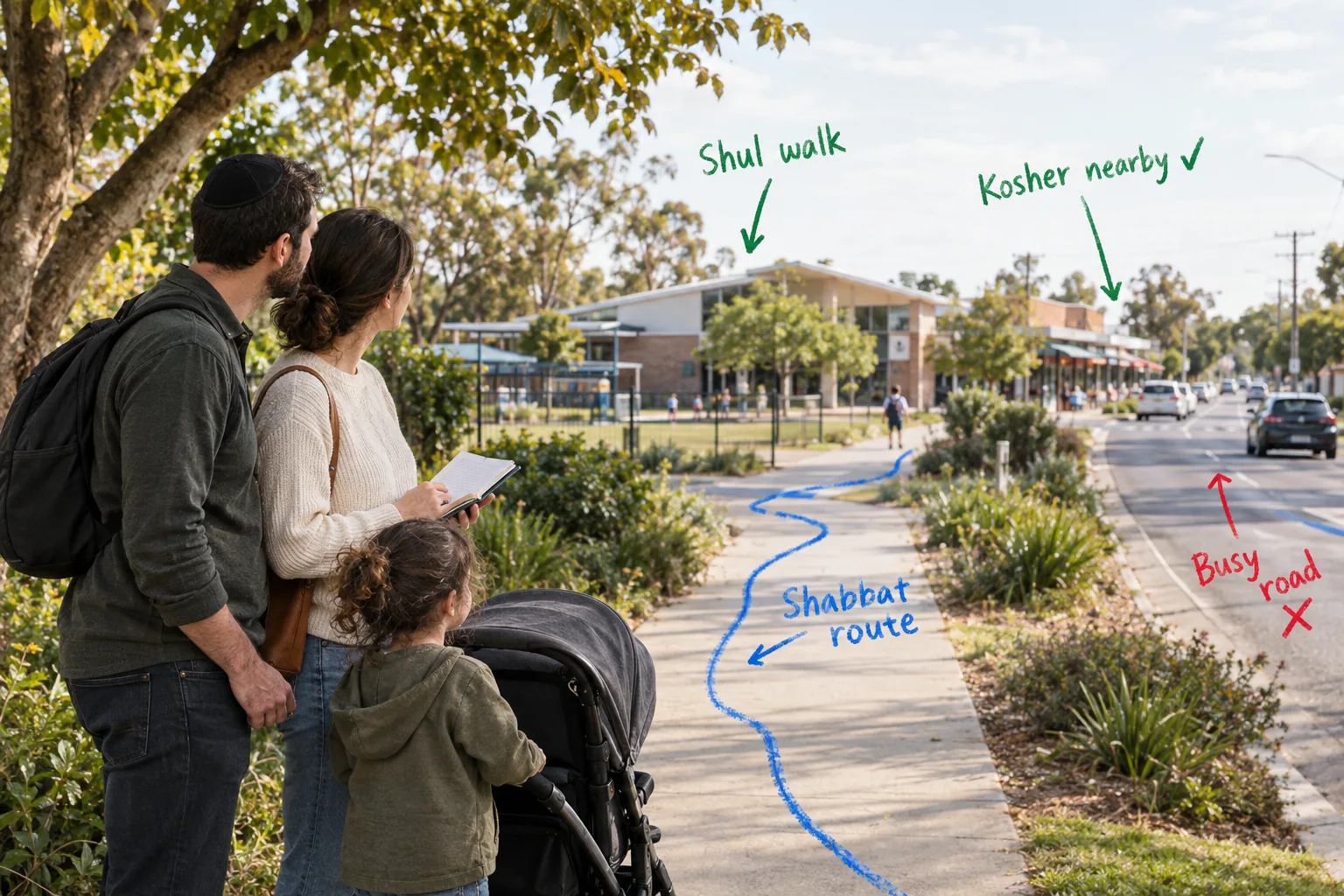
Jewish households differ in observance, denomination, community, school, and food requirements. For households that observe Shabbat without driving, the route to a preferred shul and whether an address sits within the current eruv can become a hard filter.
A suitable Jewish school, kosher supermarket or butcher, restaurant, mikvah, family network, community facility, and everyday services may shape the shortlist as much as the property itself. A nearby institution still needs to fit the household's practice, schedule, access, and community expectations.
Kaveat brings those macro-location questions into one brief so they can be compared before a property decision, while halachic interpretation, current facility status, school admission, and property due diligence stay with the appropriate authorities and professionals.
Emptor → Kaveat Area → Comparo
Set the observance context and fixed destinations that shape the decision, including a preferred shul, eruv boundary, Jewish school, kosher shops, mikvah, work, family, and services.
Separate Requirements from Preferences: an address inside the current eruv, a comfortable walking route to shul, access to a suitable school, kosher food, community facilities, or quiet streets may matter differently to different households.
Compare candidate areas and addresses, then verify the current eruv status, route safety and walking time, synagogue fit and schedule, school enrolment, kosher certification, mikvah access, and property details independently.
The Kaveat way
Turn the location question into a repeatable workflow
Define what matters, inspect the spatial result, and carry the same reasoning into the next supported step.
The intended route is Emptor → Kaveat Area → Comparo. It shows where this use case begins, not a promise that every adjacent capability is available here.
The boundary
Use the model as evidence, not a verdict
Kaveat should help you ask a better location question, not make the final decision for you.
Kaveat supports macro-location research and shortlisting. It does not interpret Jewish law, determine a household's observance requirements, certify an eruv or kosher status, assess synagogue suitability, confirm school admission, verify mikvah availability, assess community safety, or replace legal, planning, building, valuation, or other property checks.
Eruv boundaries and status can change, so confirm current information with the relevant committee or rabbinic authority before relying on it for Shabbat.
Can Kaveat tell me whether an address is inside an eruv?
Kaveat can help compare a mapped boundary where the relevant data is available. Confirm the current boundary and status with the responsible eruv committee or rabbinic authority before relying on it, especially near an edge or before Shabbat.
Can it find the right Orthodox or Jewish neighbourhood?
There is no single label that fits every Jewish household. Define the shul, eruv, walking route, school, kosher, mikvah, family, and community factors that matter to your household, then investigate the lived fit in person.
Can Kaveat confirm a place at a Jewish school or tell me which school is suitable?
No. It can help compare the location of schools and other destinations. Check admissions, eligibility, fees, transport, curriculum, affiliation, and the school's fit for your family directly.
Can it verify that food or a venue is kosher?
No. Use the current certification or guidance from the relevant kashrut authority and confirm the status of each product, venue, or service independently.
How close should a home be to a synagogue for Shabbat?
There is no single distance that fits every household. Define a realistic walking route and the synagogue, eruv, accessibility, and schedule requirements that matter to your practice, then verify them with the relevant local authorities.
Ready to capture your location needs?
Define and score every location, everywhere that's important to you.