
Plan around faith, family routines, community access, and privacy
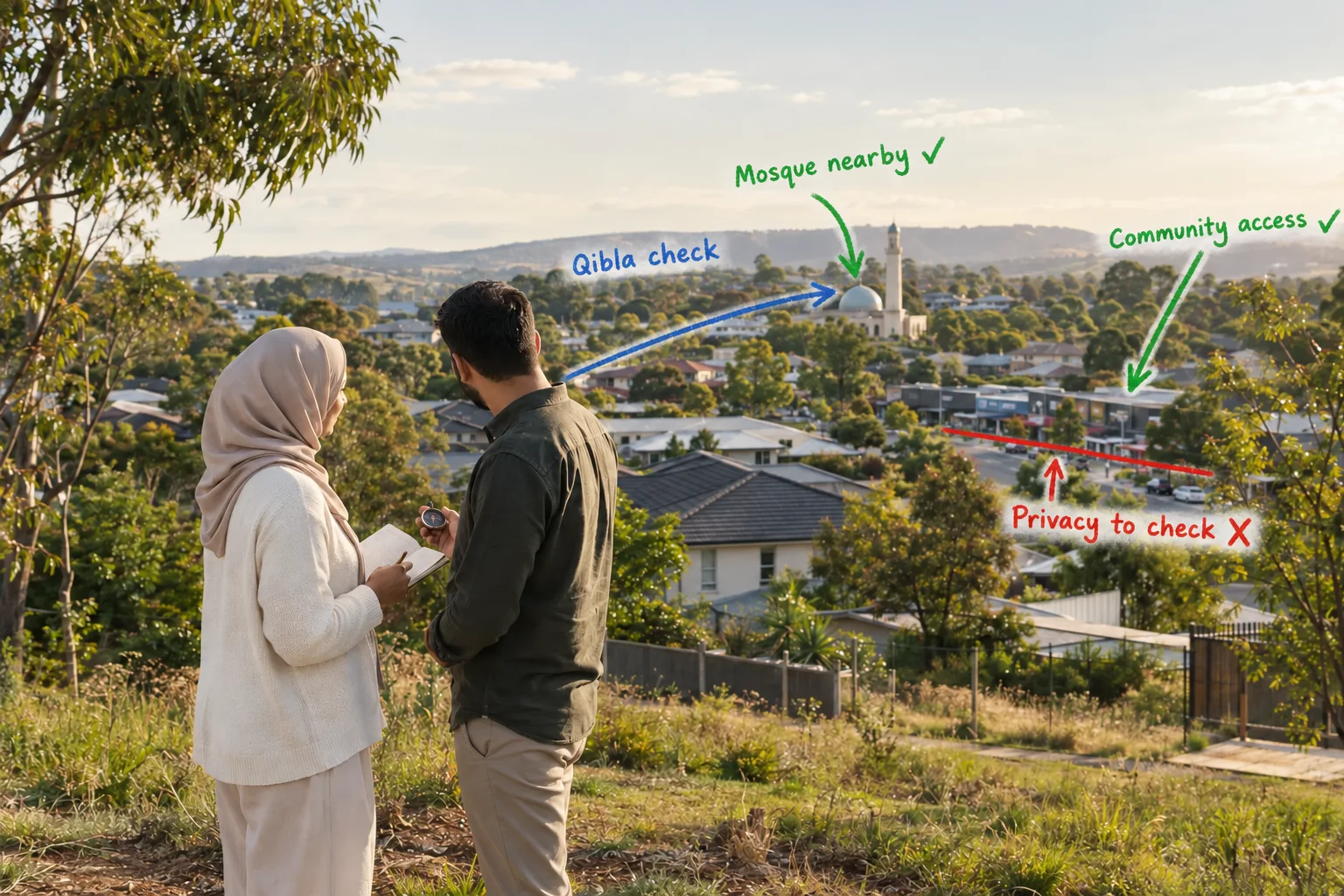
For some Muslim households and businesses, a location decision includes Qibla direction, access to mosques and Islamic schools, halal food, workplaces, schools, markets, family, privacy, quietness, daylight, services, and the surrounding environment.
Use Emptor to make those macro-location priorities explicit before comparing areas and addresses.
Emptor → Kaveat Area → Comparo context
The decision problem
A home can be near the right places and still miss the conditions that make daily life work
A suburb label rarely shows whether a household can reach the mosque, Islamic school, workplace, schools, markets, halal shops, health services, and family without exhausting daily travel.
The neighbourhood itself may matter. Some households may prefer quiet streets, privacy from busy roads and public spaces, a family-oriented environment, natural light and fresh air, and distance from waste sites, stagnant water, flooding, or industrial dust and smoke.
Kaveat brings those macro-location questions into one brief so they can be compared before a property decision, while religious guidance, room layout, exact Qibla bearing, and technical due diligence stay with trusted professionals.
Emptor → Kaveat Area → Comparo
Define the location factors that matter to your household or business, such as Qibla direction, access to mosques and Islamic schools, privacy from busy streets, quietness, daylight, natural topography, and proximity to community destinations.
Separate Requirements from Preferences, including access to the workplace, schools, markets, halal grocers and restaurants, health and community services, public transport, utilities, sanitation, and the places your family visits each week.
Compare candidate areas and addresses, then verify the exact Qibla bearing, travel assumptions, noise, traffic, drainage, flood and wet-area exposure, waste or industrial uses, daylight and ventilation, planning constraints, and the suitability of any prayer or interior spaces independently.
The Kaveat way
Turn the location question into a repeatable workflow
Define what matters, inspect the spatial result, and carry the same reasoning into the next supported step.
The intended route is Emptor → Kaveat Area → Comparo. It shows where this use case begins, not a promise that every adjacent capability is available here.
Trust the inputs
Make the reasoning clear
Kaveat keeps the inputs behind a location result in view. Use that evidence to decide what to investigate next, then add the checks the property or situation requires.
A faith-informed location model
Kaveat can rank candidate locations against the Requirements and Preferences you choose, including the places and environmental conditions that shape your week. A higher Kaveat Score means closer alignment with that model, not a religious ruling, a Muslim-friendly certification, or a guarantee that a home will meet every household need.
- Inputs stay visible
- The model can be revisited
- Further checks remain yours
The boundary
Use the model as evidence, not a verdict
Kaveat should help you ask a better location question, not make the final decision for you.
Kaveat supports macro-location research and shortlisting. It does not issue religious guidance, certify a Muslim-friendly neighbourhood, determine the correct Qibla bearing for prayer, assess the validity of a mosque's alignment, design a prayer room, decide room positioning or isolation, or guarantee privacy, safety, service quality, water, sanitation, or environmental conditions. Confirm the exact direction to the Kaaba in Mecca, utilities, site levels, sightlines, daylight, ventilation, noise, drainage, flooding, waste and industrial exposure, planning, building design, financing, and community suitability with the appropriate religious, technical, property, and financial professionals.
Can Kaveat calculate or certify Qibla alignment?
Kaveat can help you include a directional preference where the relevant location data and workflow support it. It does not provide a religious ruling or certify a prayer direction. Confirm the bearing with a trusted Qibla method, mosque, or qualified authority.
Can it choose the best room for prayer or create privacy inside the home?
Those are building-design and household decisions outside Kaveat's macro-location scope. Kaveat can help compare street exposure, surrounding uses, and broader site context before you investigate the property itself.
Can it identify a Muslim-friendly neighbourhood?
There is no single Kaveat label that can certify a neighbourhood for every Muslim household. You can compare the mosques, Islamic schools, halal grocers and restaurants, markets, services, transport, family destinations, quietness, privacy, and environmental factors that matter to your own household, then visit and speak with local community members.
Can it find areas near mosques, Islamic schools, and halal shopping?
It can help compare proximity to available community destinations and the other places you choose. Check opening hours, school enrolment, prayer and community schedules, halal certification or supplier information, transport, services, community fit, and the lived experience of the area in person.
Ready to capture your location needs?
Define and score every location, everywhere that's important to you.