
Choose a site around how customers reach your business
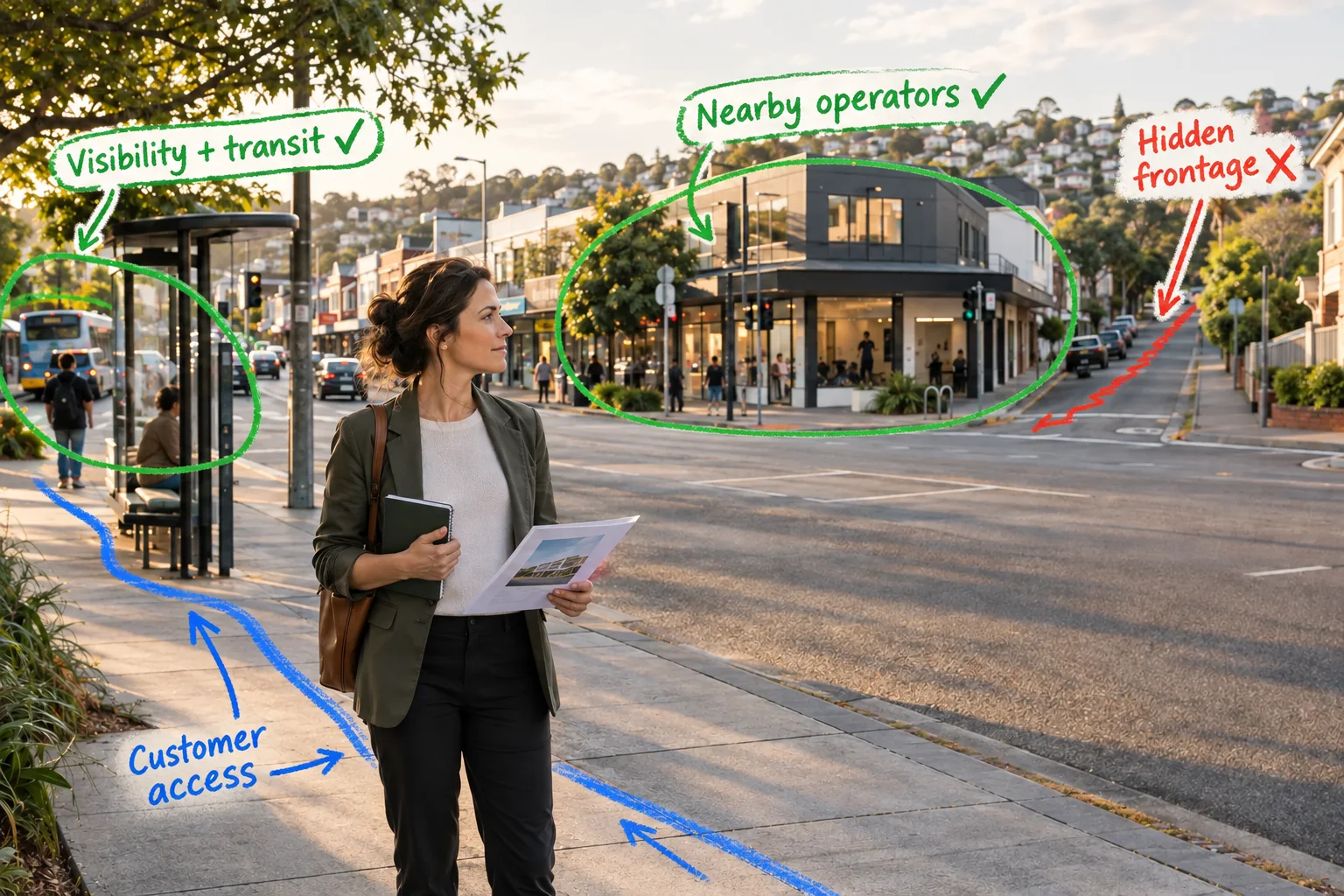
A physiotherapy clinic, gym, or other service business may value a gap in the market, a visible corner, a complementary cluster, parking, or public transport.
Use Emptor to define those trade-offs, then compare candidate catchments and addresses before you sign a lease or relocate.
Emptor → Kaveat Area → Comparo context
The decision problem
A new site has to fit the customer journey and the operation
A clinic may want nearby medical referrals, a gym may need visibility and parking, and another operator may prefer a less crowded catchment.
Suburb labels and intuition make those strategies hard to compare. Kaveat puts the access, nearby uses, and catchment assumptions into one location model before a promising lease narrows the conversation.
Emptor → Kaveat Area → Comparo
Describe the customers, catchment, access modes, parking, visibility, and nearby destinations that shape the location decision.
Model both strategies: whitespace away from direct competitors, or intentional proximity to competitors, referral partners, complementary services, busy roads, public transport, and other useful land uses.
Compare candidate areas and addresses, inspect the inputs behind the result, then verify demand, footfall, zoning, lease terms, access, parking, and site suitability independently.
The Kaveat way
Turn the location question into a repeatable workflow
Define what matters, inspect the spatial result, and carry the same reasoning into the next supported step.
The intended route is Emptor → Kaveat Area → Comparo. It shows where this use case begins, not a promise that every adjacent capability is available here.
Trust the inputs
Make the reasoning clear
Kaveat keeps the inputs behind a location result in view. Use that evidence to decide what to investigate next, then add the checks the property or situation requires.
A location strategy you can explain
Kaveat can compare candidate locations against the Requirements and Preferences you choose. A higher Kaveat Score means closer alignment with that strategy, not proof of demand, revenue, or commercial success.
- Inputs stay visible
- The model can be revisited
- Further checks remain yours
The boundary
Use the model as evidence, not a verdict
Kaveat should help you ask a better location question, not make the final decision for you.
Kaveat supports macro-location research and shortlisting. It does not forecast revenue, measure every competitor, certify foot traffic, validate market demand, negotiate a lease, assess a business plan, or replace zoning, planning, access, parking, building, financial, or legal due diligence. Nearby businesses and land uses are useful signals, not a guarantee that a cluster or whitespace strategy will work.
Should I avoid competitors or locate near them?
There is no universal answer. Model both approaches with the customer access, complementary uses, visibility, costs, and operational constraints that matter to your business, then validate each shortlist with local research.
Can Kaveat tell me where to open a clinic or gym?
It can help you compare locations against a stated business brief. It does not choose a site, predict demand, or replace your commercial, financial, planning, and customer research.
Does Kaveat measure foot traffic and customer demand?
Only use a measure when the relevant data is available and clearly represented. Treat mapped proximity and spatial context as screening inputs, then verify counts, trading patterns, access, and demand before committing.
Context and sources
business.gov.au: Choose your business locationReady to capture your location needs?
Define and score every location, everywhere that's important to you.